

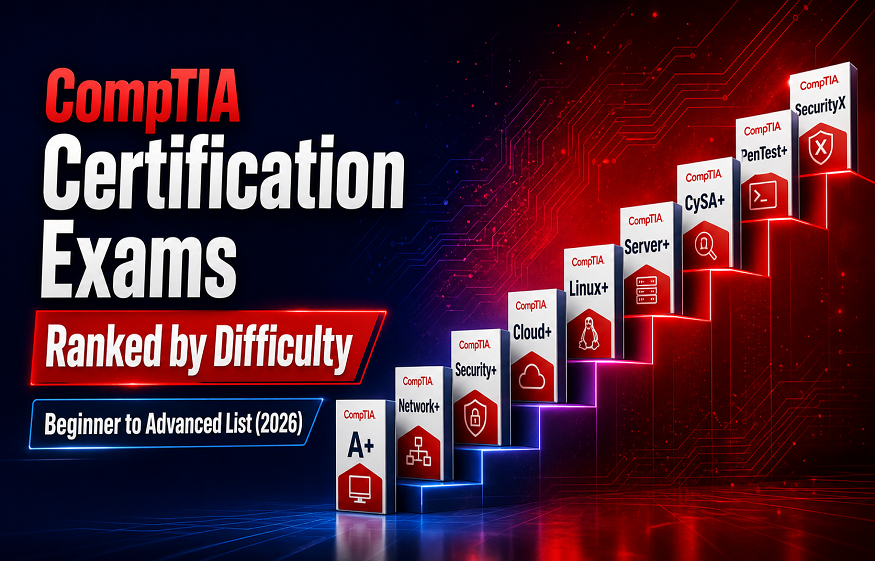
CompTIA certifications are commonly used as a method of creating IT abilities. One of the reasons they are so well-known is that they follow a clearly defined progression that starts with basic skills and progressing to higher-level, real-world problems-solving jobs.
In 2026, the candidates follow this pattern, however the difficulty of exams is higher due to the questions are more situation-based and focused on real-world problems rather than simple definitions. This article categorizes CompTIA tests from beginning to advanced, and explain what makes each level tougher.
Understanding the CompTIA Structure First
Prior to determining difficult, it is important to know the way CompTIA manages its certifications. The system is organized with layers in which each level builds upon the previous level.
The major categories are:
- Certifications for Core
- Certification of infrastructure
- Cybersecurity certifications
- Certifications at the expert or advanced level
The most popular starting path is A+ → Network+ → Security+, often called the “CompTIA trifecta,” because these certifications build fundamental IT skills gradually. To better understand this structured path and explore available exams, you can also review detailed CompTIA certification options based on your career goals.
Beginner Level: Entry Into IT
These certifications are among the easiest in terms of difficulty however, they require some work if you’re novice to IT.
Read More: A Complete Guide to Writing a Biology
IT Fundamentals or Tech+
This is a good starting place for all novices. It is focused on the most the most basic IT terms, basic concepts and the ways technology operates. It was designed for those who have no technical knowledge.
CompTIA A+
A+ marks the initial serious certification for professionals. It covers software, hardware troubleshooting, operating systems and the basics of networking. A lot of IT career paths start here as it teaches practical skills for support.
At this level, the difficulty arises from the variety of topics, not the technical complexity.
Lower-Intermediate Level: Building Core Skills
After A+ the difficulty gets more difficult due to the fact that concepts become more complex and interconnected.
CompTIA Network+
Network+ concentrates on concepts of networking such as IP routing, addressing as well as switching, wireless networks and troubleshooting. It requires a deeper understanding of the way networks communicate.
The exam is difficult because network concepts aren’t always apparent. You must imagine the way data moves within the network.
CompTIA Security+
Security+ is among the most sought-after certifications. It provides cybersecurity-related concepts such as risks and vulnerabilities, risk management as well as access management. The challenge here is the type of questions that are based on scenarios. You need to choose the most effective security option, not simply determine a term.
Read More: Why programming assignment help is
Intermediate Level: Specialized Knowledge
At this stage, the tests are focused on specific roles like cloud computing, Linux as well as server-related management.
CompTIA Cloud+
Cloud+ evaluates cloud architecture the deployment process, its security as well as operations across different platforms. It is more practical and requires a deeper understanding of the real-world cloud environments.
CompTIA Linux+
Linux+ is a system-wide course that focuses on administration, command-line use as well as scripting, permissions and troubleshooting Linux environments. It’s difficult for newbies due to the fact that it requires hands-on knowledge.
CompTIA Server+
Server+ is focused on server hardware deployment maintenance, and troubleshooting. It’s useful in infrastructure roles and requires an understanding of both the software and hardware.
As you progress, the exams get more difficult since you need to mix multiple skills rather than doing a single study.
Upper-Intermediate Level: Cybersecurity and Analysis
The certifications offered are sophisticated and geared towards practical security tasks in the real world.
CompTIA CySA+
CySA+ focuses on threat detection surveillance, management of vulnerabilities and response to incidents. It requires an analytical approach and a thorough understanding the security instruments.
CompTIA PenTest+
PenTest+ focuses on offensive security, which includes vulnerability scanning, penetration testing and ethical hacking strategies. It’s tougher since it requires technical expertise and solving problems.
At this point, the questions get more complicated. You must analyze the situation and make decisions instead of just finding solutions.
Advanced Level: Expert Certification
CompTIA SecurityX (formerly CASP+)
This is the top-level CompTIA certification. It focuses on security in the enterprise design, architecture as well as risk management. It also covers advanced troubleshooting.
It doesn’t test just skills. It tests the ability to make decisions at an expert level. Candidates are required to create secure environments and resolve complex security challenges. This isn’t easy due to the fact that it requires actual expertise, not only studies.
Difficulty Ranking Table
| Certification Level | Exams | Difficulty | Why It Feels Hard |
| Beginner | ITF+, A+ | Easy to Moderate | Broad topics, fundamental concepts |
| Core | Network+, Security+ | Moderate | Technical depth and scenario-based questions |
| Intermediate | Cloud+, Linux+, Server+ | Moderate to Hard | Integration of multiple skills and practical experience |
| Advanced | CySA+, PenTest+ | Hard | Security tools, analysis and real-world scenarios |
| Expert | SecurityX (CASP+) | Very Hard | Architecture, decision-making, enterprise security |
This concept is explained in greater depth in a YouTube video shared by Cert Empire.
What Makes CompTIA Exams Hard in 2026
The primary reason that these tests are more difficult now is due to the shift towards real-world situations. Instead of simply asking questions, the exams focus on business issues and demand the best solution from technology.
The other reason lies in the expanding dimension of IT. Some of the introductory certifications today include cloud fundamentals, security awareness as well as hybrid systems. This adds to the amount of information required.
Additionally, the performance-based questions create difficulty. These types of questions mimic real-life tasks, like setting up settings or solving issues.
How to Choose the Right Starting Point
Selecting the appropriate test level will save you time and cut down on difficulty.
If you’re new to IT Start by taking IT Fundamentals and A+. If you’re already proficient in the basics of IT, you can start using Network+ or Security+. If you’ve worked in the field it is possible to move straight towards Cloud+, CySA+ or any other certifications that are specialized. The most important thing is to match your current level of knowledge to the level of the test. If you start too high, it will make the exam more difficult and can slow your advancement.
Preparation Strategy Based on Difficulty
For exams for beginners, concentrate upon understanding basic concepts and the terminology. Practice with simple questions and basic tests.
For exams for intermediate level, mix practical exercises with the theoretical knowledge. Learn about how systems interact and experience real-world scenarios.
For more advanced exams, you should focus on decision-making and analysis. Review questions based on scenarios, practice mistakes and determine what makes one answer better over the other.
Cert Empire is a great tool to use during revision when you need exam-style CompTIA questions that include explanations, particularly to understand how the questions are designed.
Final Verdict
CompTIA certificates follow a clearly defined course of study that goes from beginning to expert. The tests are not intended to fool you, however they require you to be able to comprehend.
Exams for beginners test basic understanding. The core exams test the technical ability. Intermediate exams test combined skills. Advanced tests analyze test results. Expert exams test decision-making. Should you choose the correct method and work in a systematic manner each step, even the most difficult CompTIA certification is manageable.
FAQs
-
Which is the most straightforward CompTIA certification?
The most straightforward CompTIA accreditation to earn is IT Fundamentals or Tech+ since it focuses on the most fundamental IT concepts and does not require prior experience in technology to begin studying.
-
What is the toughest CompTIA certification?
The most difficult CompTIA certificate is SecurityX earlier called CASP+, because it examines advanced security infrastructure, enterprise-level choices and the ability to solve real-world problems.
-
Are you sure that CompTIA A+ the right level to kick off getting a job in IT?
CompTIA A+ will be sufficient to begin entry-level IT jobs such as help desk and support technician. It includes the important hardware software, as well as troubleshooting abilities that are needed in actual jobs.
-
Should I omit A+ and instead start using Network+?
You may bypass A+ If you are already familiar with the fundamental IT concepts. But, those who are new to IT will benefit from A+ as it helps to build solid foundations before advancing into networking issues.
-
What is the time frame in order to go through the CompTIA route?
The full CompTIA process can take from between one and two years, based on your time spent studying the level of experience you have, as well as the number of certifications you intend to attain.